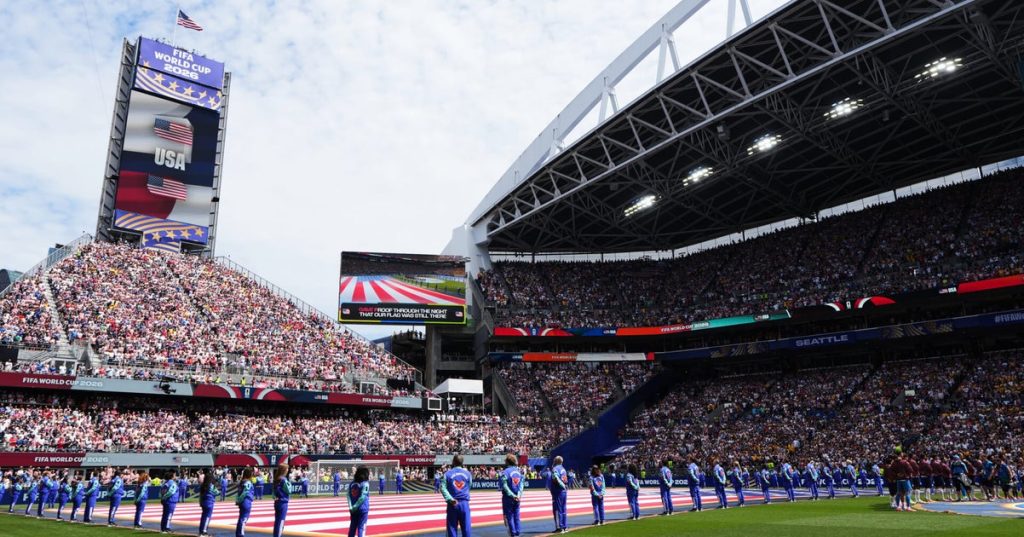
SEATTLE — Major League Soccer commissioner Don Garber stood on the pitch in Seattle, looked around at the tens of thousands of fans and felt tears welling in his eyes.
It was 2009, 17 years before the Seattle crowds would capture a nation by serenading the U.S. World Cup team with “Country Roads” and prepare to host a blockbuster round-of-16 showdown, and the Sounders were playing their inaugural game in MLS. Garber saw the march to the match, the fans dressed in rave green and understood immediately what it meant: People would see these scenes and think differently about the potential for soccer in America.
“For the first time I said, this is it, we have something here,” Garber recalled to The Athletic this week. “That if we keep doing what we’re doing, with the right owners, with the right cities, in the right stadiums, we’re going to crack that code.”
Garber was right. Seattle changed minds about the potential for the sport, and it sold expansion teams around the continent — in Montreal, Orlando, New York City, Atlanta, Minnesota, Los Angeles and beyond. On the heels of Seattle’s success, MLS built out its footprint and its infrastructure, creating a permanence that never before existed for soccer in America.
That development is the foundation that made this 2026 World Cup possible.
Nearly two decades later, the Emerald City once again has a chance to host a potential step-function moment for American men’s soccer. This summer’s 2026 World Cup was billed as “rocket fuel” for soccer in America. The U.S. men’s national team declared the tournament part of their mission to “change American soccer forever.”
After pulling the country onto its bandwagon — a record 33.5 million people tuned in to the knockout win over Bosnia, a number that outranked the 2026 NBA Finals and would have finished in the top five most-watched television events in 2025 — the fate of those hopes rest largely on what happens when the U.S. takes the field on Monday against Belgium.
Win, and they become just the second American team of the modern era to advance to a World Cup quarterfinal. Only this team, unlike the one in 2002, will do so on home soil, with record-setting audiences and a sport with a resonance that is radically different in the U.S. today. Lose, and the sport will no doubt lament the missed opportunity of this moment, one that extends beyond even the U.S. result.
Seattle Sounders fans march to their inaugural MLS match in March 2009 (Ted S. Warren / AP Photo)
That so much hinges on a game that will happen here on the banks of Elliott Bay, where an American soccer culture was established in the 1960s with the North American Soccer League and grew with MLS in the early 2010s, is appropriate.
There is perhaps no city more closely linked to the evolution of the sport in America and none better suited to the moment.
“All of (Seattle’s soccer history) is, to me, the powder keg on which this recent passion has exploded,” Sounders owner Adrian Hanauer told The Athletic. “But I’m also a real pragmatist. The World Cup will be over in a few weeks, and then it’ll be back to the grind of how we improve our league, how we bring more fans into the game, how we translate their engagement in the World Cup into engagement in league soccer and participation in soccer.”
Another U.S. win would go a long way toward extending the tail of this summer’s brilliant show and making an American soccer moment evolve into an American soccer legacy.
Why Folarin Balogun’s reaction to his red card set the standard
Henry Bushnell
U.S. national team midfielder Tyler Adams was all of 3 years old when Landon Donovan, Brian McBride, DaMarcus Beasley and the 2002 U.S. World Cup team shocked the world by advancing to the World Cup quarterfinals in South Korea. Danielle Reyna was pregnant with Gio Reyna as Claudio captained that team. Defender Alex Freeman would not be born for another two years.
There isn’t just an entire generation of American sports fans with no memory of that team, they’re on the field playing in this World Cup. That the U.S. is here, 24 years later, still trying to reach those levels speaks to the ongoing battle to build American men’s soccer.
It’s why the sold-out stadiums and watch parties have so deeply impacted the U.S. team. This group came into the tournament understanding the stakes. They have been raised as a “golden generation” of American men’s soccer, a group of players who benefitted from the globalization of the sport, of global scouting networks and greater access to professional academy systems, and who found success on bigger stages at the club level than any American players before them.
What Christian Pulisic did to open doors to Europe for Americans at younger ages, and what those players have accomplished at clubs like Schalke and Dortmund, Chelsea, Milan and Juventus represented progress.
But translating that club success to something that permeates into the fabric of the sport back home requires a bigger moment — or movement. And there would be no greater opportunity than this World Cup.
It’s why the last two cycles were built first around the idea of changing how people think about American soccer and then changing American soccer forever.

Chris Richards gets playful with Tyler Adams after the USMNT’s win over Bosnia and Herzegovina in the World Cup round of 32 (Carlos Barria / Reuters)
“As a team we want to kind of leave our mark on the game and a legacy behind,” Adams said this week. “I want it to be more than just what this moment has created and the hype around it. If we’re talking about the team and the success that they’ve had two years from now, then we’ve done something right. … We know the further that we go, the more success we’re going to have, and the growth of the game is going to grow (with it).”
Even coach Mauricio Pochettino’s favorite mantra — ”Why not us?” — hinges on that same concept. There has to be belief that American soccer can compete in order for it to compete. But that buy-in has to actually be fortified by something tangible.
A win on Monday propels the U.S. to that stage. It goes beyond the normal expectation.
“We’ve all said, in one way or another, how (much of an opportunity) this tournament could be,” U.S. captain Tim Ream said. “If we have a good tournament and we do things the right way, it could take us who knows where.”
The U.S. must do its job against Belgium. But that next part — where it goes — hinges on others. As Hanauer said, it’s “back to the grind” to convert a summer of soccer into something more lasting.

Pochettino stood on the field in Columbus, Ohio, for a heavily-anticipated Texas-Ohio State college football game in August 2025, looked around at stands in the Horseshoe and wondered what needed to happen for similar crowds of 107,524 to show up for soccer.
“My question was: ‘Why not?’ If the fans are very passionate, why aren’t they with us, with soccer,” he said earlier this summer. “If the American people start to show passion in our sport, too. … That is the most important legacy, the connection between the team and the national team and the fans. It’s not to win the World Cup. Of course we want to win. But that is the legacy that we need if one day we want to be very successful and be consistent.”
It is, of course, the last major step for the sport in this country. Soccer, once a fringe sport, has grown by magnitudes since the last time a men’s World Cup was hosted here in 1994. MLS thrives in several markets. The Premier League on NBC mainstreamed the sport. “Ted Lasso” and “Welcome to Wrexham” crossed over into pop culture relevance. Liga MX remains the most popular league on television in the country. CBS’s Champions League coverage has become a globally popular show via social media that has reached the younger generations. The NWSL and U.S. women’s national team remain enormously popular.
But turning that fractured and piecemeal popularity into a more direct competitor in the American sports landscape has proved exceedingly difficult for men’s soccer.
“I don’t think we have the answer,” Hanauer said, when asked how to convert World Cup fans into longer-standing ones. “One thing that is crystal clear is there are a lot of soccer fans in this country. … I’m inspired, I’m hopeful, and I know that there is a path to translating all this excitement and energy into continued growth for my league and my team, so that that is exciting. And anybody who thinks that that isn’t possible or plausible isn’t paying attention to what’s going on in the country.”
MLS will soon launch a marketing campaign around the idea of, “Thanks world, we’ll take it from here.” How ready they are to do so remains up in the air. The league has already voted to flip its calendar and change its competition structure to encourage more games of consequence and take a more active role in the global transfer market beginning in 2027.

USMNT manager Mauricio Pochettino meets MLS commissioner Don Garber during his introductory press conference in September 2024 (Stephen Nadler / ISI Photos / Getty Images)
But the most important point of change, altering roster rules to allow the league to better compete, is not yet done.
Garber said the league has focused since 2018, when the U.S., Canada and Mexico were awarded these World Cup hosting rights, on “the foundational work” in the lead up to this summer’s tournament. That has been done “lock, stock, and barrel,” he said.
But in order to make domestic American soccer resonate, there is much left to do. As the Olympics show every two years, the patriotism and “big event” feel of a World Cup won’t guarantee people stick around when it’s all over.
Mostly, they don’t.
But this country’s willingness to embrace the World Cup — and the evidence that it’ll show up to watch the world’s best players in other competitions like the FIFA Club World Cup, summer Premier League friendlies and even to watch Lionel Messi and Inter Miami — indicate there is a path toward capturing more casuals.
“The ratings for the U.S. game were equivalent to the NBA finals. There are people in this country who love the game if you give them the environment and the product that they could care about,” Garber said. “It’s no different than them loving one of the other major league teams, or loving a team in any other part of the world. We need to begin to start delivering the product that the country has shown they will get excited about.”
The path to get there will not be easy. In MLS’s own boardroom there are different ideas about how to achieve that better product. And there are obvious questions about if a domestic league can ever deliver the way a World Cup — or even the Premier League — can.
But just as the sport has seen these moments of incremental growth along the way — from the 1994 World Cup, to the launch of MLS two years later, David Beckham’s arrival in 2007 and the Seattle Sounders’ success two years after that — this 2026 World Cup, and the U.S.’s team success in it, can be yet another opportunity to move toward a reality where American soccer matters more.
The World Cup “is not a silver bullet,” Garber said. But it can be a pathway to real change.
A win Monday and a deeper run by the U.S. team would only aid in cutting a rough track toward that end. It would make people think differently about American men’s soccer. And that belief is needed for progress to really take hold.